Energy Efficiency Pays: How 179D and Tax Rebates Make HVAC Projects More Affordable
Discover how mechanical contractors and end-users can leverage federal tax deductions, state tax rebates, and energy efficiency upgrades to reduce construction costs—with important opportunities ending June 30.
DISCLAIMER: Cambridge Air Solutions is not a tax expert; we are experts in enriching lives through our air solutions. Contact a tax specialist to find out definitively which tax solutions are right for you.
When starting construction on a new building, there are many challenges that must addressed, and the costs can add up. Proper heating, cooling, and ventilation are necessary for these projects, and it can become overwhelming to balance the budget. But it doesn’t have to be such a burden. In this article, we will highlight the several tax incentives, rebates, and deductions that reward those who choose energy efficient options for their buildings or projects, both at the national and state level.
Understanding Commercial HVAC Rebates
There are several different types of rebates that could be applicable depending on your state, the type and scope of the project, and the type of air solution you decide to use in the facility.
- Utility-sponsored rebate programs
- They’re a public fund that is used to incentivize individuals and businesses to go green by installing high-efficiency equipment and providing them with a rebate.
- Prescriptive vs. Custom rebates
- Prescriptive – these are set rebates depending on what equipment is bought. There is a predetermined dollar amount, and are for the more commonly seen equipment in the market.
- Custom – an expert will come analyze the building and energy usage and then will award the owner with money depending on how efficient the building is. These require pre-approval and often take more time to receive, but they usually get the owner of the building more money.
- State and regional energy efficiency incentives
- Vary heavily from state to state. Some states, like California, have 151 different incentives available, while others, like Kansas, only have 12.
- To find out which programs are available in your area, visit the DSIRE website.
The Federal Incentive
NOTE: As of June 11, 2026, Section 179D is being sunset under President Trump’s One Big Beautiful Bill Act. Buildings whose construction is started after June 30, 2026, will not be able to apply for this funding.
While there are several tax incentives that vary from state to state, there is one that is consistent everywhere in the country – Section 179D. Section 179D is a tax deduction for building owners who place in service energy efficient commercial building property (EECBP) or energy efficient commercial building retrofit property (EEBRP) and may be available to claim a tax deduction.
EECBP must be installed on a building following the scope of specified Reference Standard 90.1 as laid out by ASHRAE, and it must be part of a plan to reduce the total annual energy and power costs by 25% or more in comparison to a reference building that meets the above requirements.
EEBRP must be installed on buildings that meet the same ASHRAE standards, but it also must be on a building that was originally placed in service no less than 5 years before the establishment of a qualified retrofit plan for the building.
For larger facilities, the savings can be massive. Below is a chart from the IRS website that lays out the deductions per square foot from previous tax years:
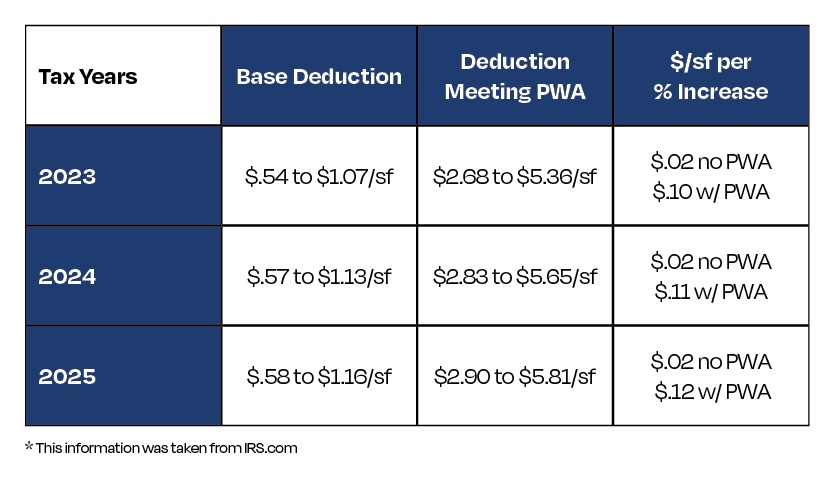
To learn more about specific building qualifications and saving opportunities, visit the IRS website and learn more.
How Rebates and Tax Incentives Work Together
The savings that are possible from Section 179D are very nice, but that’s only the start; once building owners begin stacking local incentives and rebates along with the Section 179D savings, they can potentially save hundreds of thousands of dollars.
Let’s say a building owner or facility leader decides to pursue an HVAC project that fit the description for both a local utility rebate and Section 179D for a building that is 50,000 square feet, and let’s say this HVAC project costs $500,000. If they were to use a piece of equipment that has a prescriptive rebate, such as the Cambridge Air Solutions S-Series, they can save up to $12,500/heater depending on the location, and, if they meet all the necessary requirements for maximum money through Section 179D, they could save over $290,000. On top of these savings, they will save more on their utilities year over year by opting to use a more energy efficient HVAC solution.
The math is simple – the incentives available for an HVAC project can make the price tag for a more energy efficient option shrink dramatically.
Common Mistakes That Leave Money on the Table
There’s plenty of money out there, but it’s not always claimed. Make sure you or your customers are getting the most value out of an HVAC project by:
- Investigating incentives BEFORE purchasing equipment.
- Checking and being on time for application deadlines.
- Documenting all energy savings year after year.
- Involving manufacturers, contractors, and sales reps familiar with incentive programs.
Conclusion
We understand major construction projects can be daunting and expensive, so it may be attractive to choose the HVAC solution with the lowest upfront cost, but, in the long run, it can save so much more money to choose the most energy-efficient models, like the Cambridge S-Series. With these tax incentives, those upfront costs become much less daunting, and the savings will start piling up. Are you working on a project? Reach out to one of our experts today to see how we can help you!